Bee Thorax Detection with DINO
Image segmentation of honeybees using DINO:
This past year, I have been working in WaggleNet, a student run research group at UIUC. We develop technology for beekeepers and honeybee researchers.
Our Bee Tagging project creates a machine that automatically places tags (small QR codes) on the thoraxes of bees. This allows researchers to track their hive population.
In the software team, we developed a neural network that computes the location of the bees’ thorax in an image. We used DINOv2, a ViT model created by Facebook AI; and a small convolutional head trained for this specific task.
DINOv2 was trained on a large number of unlabeled images. Through concept-invariant image transforms, the network learns visually salient features. We take one of the intermediate layers (which is a 384 dimensional patch-aligned feature) and feed it into a convolutional head with only 1K parameters. We train the convolutional head on a small set of 100 manually labeled thoraxes, and the model is able to generalize on images from a different source.
Using a large pretrained model allows the network to generalize easily, and using a small head makes our training process much easier.
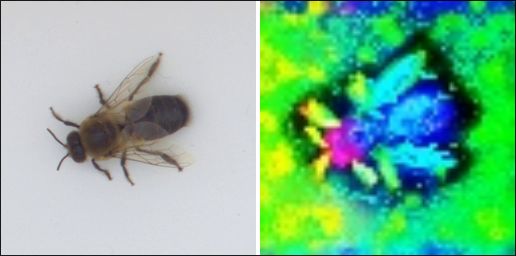
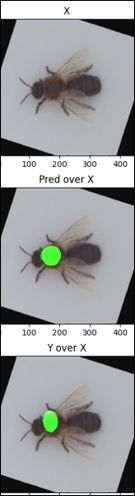
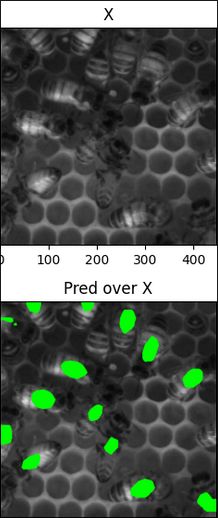
Attached are a 3 dimensional PCA visualization of a DINO intermediate layer; the prediction and ground truth on a validation sample; and the prediction in a completely different context.